
A couple of U.S. Military web subdomains had been defaced in a 404 hijacking marketing campaign, CyberScoop has showed.
As of Monday morning, error pages on two U.S. Military internet sites – oil.military.mil and ai2c.military.mil – displayed defacement messages visual to customers. The messages denigrated President Donald Trump and United States Ambassador to Türkiye Tom Barrack, known as to “FREE KURDISTAN,” And incorporated any other line studying “Kurdish sr was here.”
Some of the internet sites, oil.military.mil, belongs to the Military’s Open Innovation Lab, a check mattress for tool and cyber functions established in 2020. The opposite belongs to the Synthetic Intelligence Integration Middle, established in 2019 to combine AI applied sciences into the Military and educate group of workers on rising applied sciences.
Screenshot of 404 error pages for oil.military.mil, defaced with pro-Kurdistan feedback and insults to President Donald Trump and White Area marketing consultant Tom Barrack. (Supply: U.S. Military site)
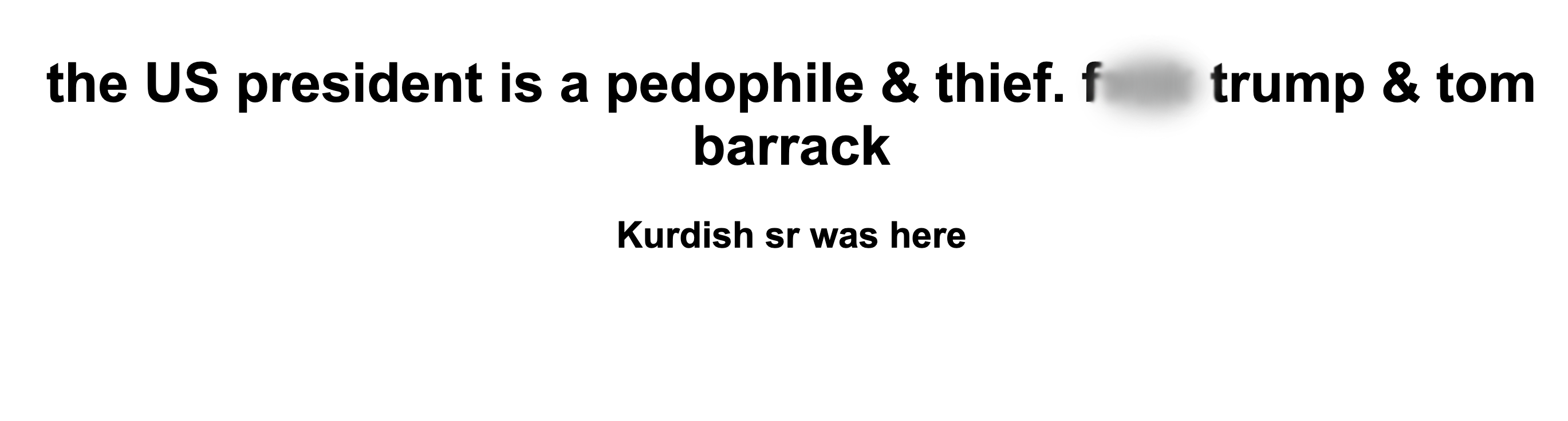 Screenshot of 404 error pages for ai2c.military.mil, defaced with insults to President Donald Trump and White Area marketing consultant Tom Barrack and an indication off from “Kurdish sr.” (Supply: U.S. Military site)
The defacements had been to start with found out via impartial cybersecurity researcher Ronald Lovelace, who notified U.S. Military officers and CyberScoop.
404 hijacking exploits a site’s error-handling device — frequently via compromising a plugin, content material control device, or server configuration — to keep watch over what content material will get displayed when a web page isn’t discovered, moderately than breaching the web page’s core pages immediately. This we could malicious customers insert defacement messages, malicious redirects, or different unauthorized content material that guests see in particular on error pages, now and again making the compromise more difficult to discover since the remainder of the web page seems untouched.
Lovelace stated the affected websites run on WordPress and Microsoft cloud infrastructure. It’s now not transparent how lengthy the subdomains had been compromised or whether or not different subdomains are affected.
“It raises the severity a decent amount because it shows it’s a bit deeper than just one single path” that’s being corrupted, Lovelace stated.
Alternatively, whilst the defacement’s presence throughout a couple of subdomains suggests the possibility of “broad reach,” it doesn’t seem to impact all Military internet sites, with many nonetheless appearing commonplace 404 error pages.
Additionally unclear presently is how the hackers received the power to edit error pages for the ones internet sites, whether or not the breach originated internally if it used to be because of an inside or via a 3rd get together breach, and whether or not the intrusion extends past restricted site defacement.
The internet sites had been taken offline after CyberScoop reached out to the Military for remark. An Military spokesperson informed CyberScoop that the pages had been hosted on a legacy third-party platform that isn’t attached to the Military’s undertaking community and feature since been got rid of.
The spokesperson stated incident reaction via Military cyber investigators stays ongoing, and that it’s too early to mention whether or not the third-party platform will likely be patched or discontinued.
“We are aware of unauthorized defacements on the error pages of oil.army.mil and ai2c.army.mil, which are hosted on a legacy, non-authoritative platform,” stated Military spokesperson Maj. Sean Minton in a commentary. “Technical teams took immediate action to mitigate the issue, and the affected pages have been secured. The Army takes all cyber incidents seriously and is actively investigating this matter to enforce our strict cyber defense and network security standards.”
It’s now not transparent who’s in the back of the defacement past the references to Kurdistan— a geographic area spanning portions of Turkey, Iraq, Iran and Syria this is house to greater than 30 million Kurdish other people. The Kurdish separatist motion has fought for many years to determine an impartial country, and defacing executive internet sites has lengthy been a well-liked tactic amongst Kurdish hacktivists.
Trump and Barrack drew the ire of Kurdish proponents previous this 12 months for seeming to again a Syrian executive army marketing campaign to reestablish federal keep watch over over Kurdish-majority lands.
It’s now not the primary time that Military internet sites had been apparently compromised via overseas hackers. In 2015, Military officers needed to quickly close down main internet sites, together with the Military major house web page and the Division of Protection’s U.S. Strategic Command, after hackers from the Syrian Digital Military defaced them.

Written via Derek B. Johnson
Derek B. Johnson is a reporter at CyberScoop, the place his beat comprises cybersecurity, elections and the government. Previous to that, he has equipped award-winning protection of cybersecurity information throughout the private and non-private sectors for quite a lot of publications since 2017. Derek has a bachelor’s stage in print journalism from Hofstra College in New York and a grasp’s stage in public coverage from George Mason College in Virginia.